Raising Whole-Brain Children Through Adventure

What The Whole-Brain Child Teaches Us About Family Travel, Emotional Resilience, and Connection
Modern parenting often feels like firefighting.
Meltdowns.
Screens.
Sibling conflict.
Emotional overwhelm.
Short attention spans.
Constant stimulation.
Many parents feel trapped between two extremes:
overly harsh parenting that focuses only on behaviour,
or permissive parenting that avoids boundaries altogether.
But The Whole-Brain Child offers a radically different framework.
The fundamental argument of the book is this:
Much of children’s difficult behaviour is not rebellion — it is dysregulation.
Children are not miniature adults with fully functioning emotional systems. Their brains are still under construction.
When we misunderstand this, parenting becomes dominated by punishment, frustration, shouting, and power struggles.
But when we understand how the brain develops, we stop asking:
“How do I control this child?”
And begin asking:
“How do I help this child become integrated, resilient, emotionally healthy, and connected?”
The Core Idea of The Whole-Brain Child
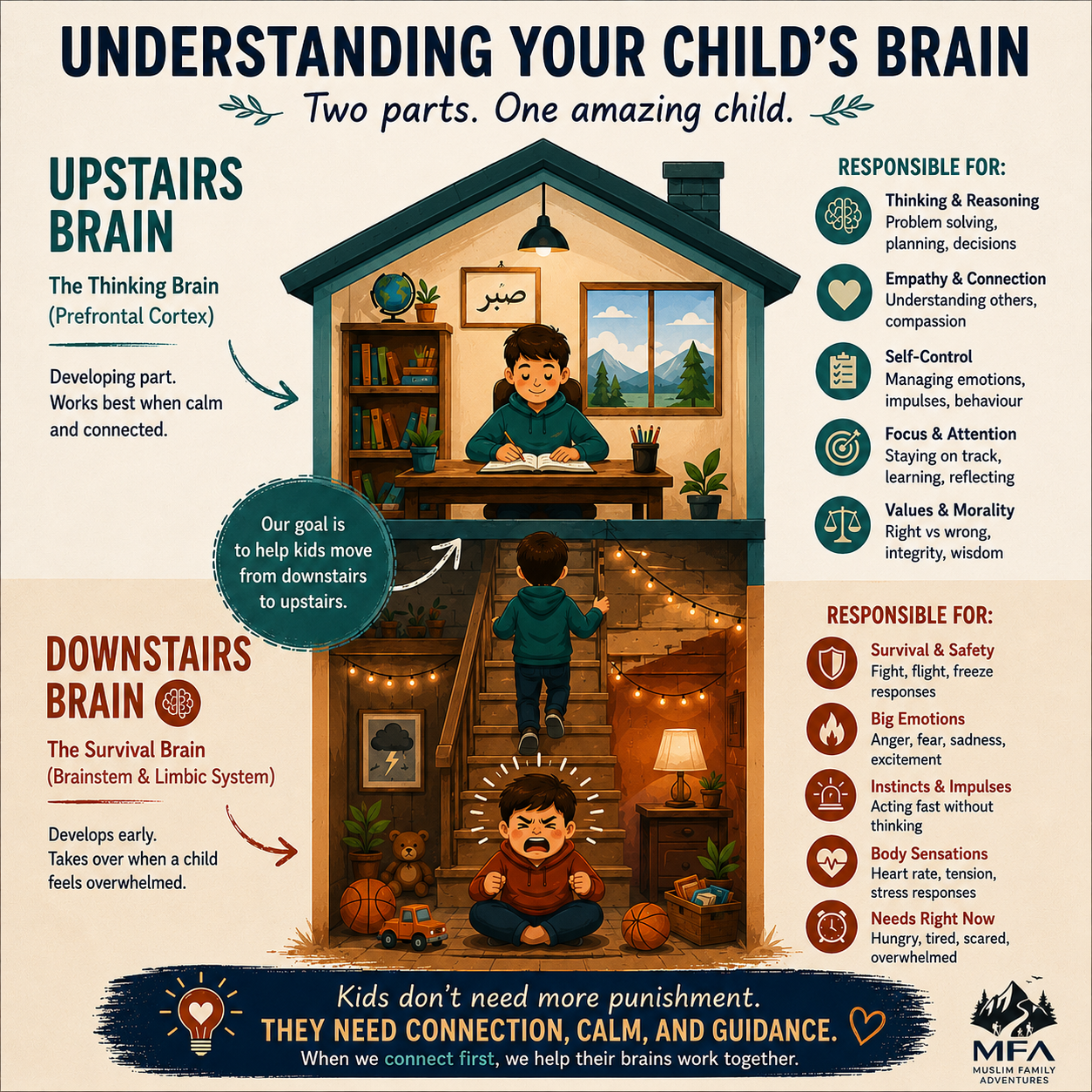
The book argues that healthy children are not children who never feel anger, fear, frustration, or sadness.
Healthy children are children who gradually learn to integrate different parts of their brain.
The authors describe two simplified parts of the brain:
The “Downstairs Brain”
The reactive part responsible for:
survival,
impulses,
fear,
anger,
emotional flooding,
fight or flight.
The “Upstairs Brain”
The reflective part responsible for:
empathy,
wisdom,
self-control,
planning,
morality,
emotional regulation.
The problem is that in children, the upstairs brain is still developing.
So when a child is overwhelmed emotionally, the upstairs brain effectively “goes offline.”
This changes everything about how we respond.
Because a dysregulated child cannot effectively process lectures, threats, or punishments.
Before correction can happen: connection must happen.
The Real Goal of Parenting
The book repeatedly returns to one powerful concept:
Integration
Integration means helping children connect:
emotions with logic,
experiences with meaning,
instinct with reflection,
self-awareness with empathy,
independence with relationships.
In other words:
The goal is not merely obedience.
The goal is to raise emotionally integrated human beings.
Children who can:
regulate themselves,
recover from difficulty,
navigate relationships,
reflect deeply,
and respond wisely under pressure.
This has profound resonance with Islamic tarbiyah.
Because Islam is not simply behaviour modification.
It is the cultivation of:
sabr,
ihsan,
emotional discipline,
mercy,
courage,
reflection,
gratitude,
and balance.
The 12 Strategies of The Whole-Brain Child
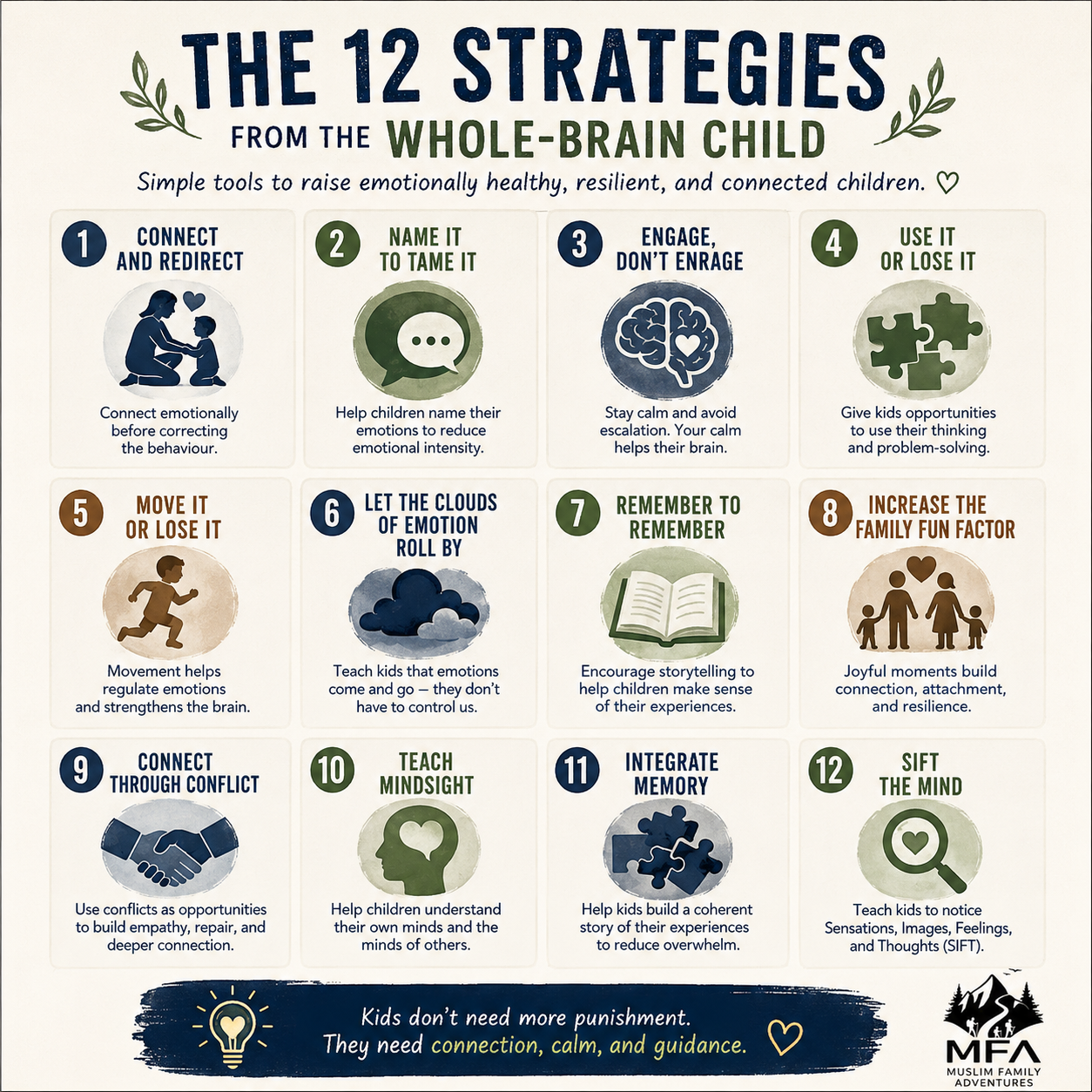
1. Connect and Redirect
First connect emotionally, then correct behaviour.
Ahmed throws his shoes across the hallway after football practice because he’s upset that his team lost. Instead of immediately shouting, his father kneels beside him and says:
“Looks like you’re really disappointed today.”
After Ahmed calms down, they talk about respectful behaviour and cleaning up the shoes together.
The correction comes after connection.
2. Name It to Tame It
Help children put feelings into words.
Amina comes home quiet after school and suddenly bursts into tears over something small.
Her mother gently says:
“I think you felt embarrassed when the teacher corrected you in front of everyone.”
As Amina describes what happened, her body relaxes. The emotion becomes manageable because it has been named.
3. Engage, Don’t Enrage
Avoid escalating the child’s emotional state through:
shouting,
shame,
threats,
humiliation.
Yusuf refuses to get into the car and begins shouting.
Instead of threatening punishment, his mother lowers her voice:
“You really don’t want to leave the park right now, do you?”
The calm tone helps Yusuf’s nervous system settle instead of escalating into a full meltdown.
4. Use It or Lose It
The upstairs brain strengthens through use.
Give children opportunities to:
make decisions,
solve problems,
reflect,
take responsibility.
Yusuf refuses to get into the car and begins shouting.
Instead of threatening punishment, his mother lowers her voice:
“You really don’t want to leave the park right now, do you?”
The calm tone helps Yusuf’s nervous system settle instead of escalating into a full meltdown.
5. Move It or Lose It
Physical movement helps regulate emotions.
After a difficult homeschooling session, two siblings are frustrated and arguing constantly.
Instead of forcing more sitting and talking, the family goes for a long woodland walk.
By the end of the walk, the tension has disappeared.
Movement helped reset the nervous system.
6. Let the Clouds of Emotion Roll By
Teach children that feelings are temporary.
Layla is devastated because her friend ignored her at a gathering.
Her father says:
“This feeling feels huge right now, but emotions are like clouds — they move and change.”
Instead of panicking about the feeling, Layla learns to observe it without being controlled by it.
7. Remember to Remember
Help children process difficult experiences through storytelling.
After a frightening thunderstorm during a camping trip, little Ibrahim keeps mentioning the loud thunder repeatedly.
At bedtime, his mother helps him retell the story:
what happened,
how scared he felt,
how the family stayed together,
and how the storm passed.
Retelling the story helps his brain process the fear safely.
8. Increase the Family Fun Factor
Shared joy builds resilience and connection.
One evening on retreat, the family sits around a campfire roasting marshmallows and telling stories.
Everyone laughs.
No phones.
No rushing.
No lectures.
Months later, the children still talk about that night.
Joyful moments create emotional security that children carry for years.
9. Connect Through Conflict
Conflict becomes an opportunity for growth through teaching:
empathy,
accountability,
listening,
repair.
Two brothers argue over who gets to paddle the kayak first.
Instead of deciding instantly, their father gathers them and asks:
“Help me understand what each of you is feeling.”
The boys listen, negotiate, apologise, and eventually work out a solution together.
The conflict becomes a lesson in empathy and repair.
10. Teach Mindsight
Help children understand their own minds and the minds of others.
After snapping at his sister, Hamza later reflects with his mother:
“I think I was already tired before she touched my stuff.”
His mother asks:
“How do you think she felt when you shouted?”
Hamza begins recognising both his own emotions and someone else’s perspective.
This is mindsight.
11. Integrate Memory
Help children make coherent sense of their experiences.
After moving house, Mariam becomes unusually anxious and emotional.
Her parents realise she hasn’t fully processed the change.
Over several evenings they talk together about:
what she misses,
what feels different,
what feels exciting,
and what still feels uncertain.
As the experience becomes organised into a story, her anxiety begins to settle.
Unprocessed experiences often become emotional triggers later.
12. SIFT the Mind
Teach children to notice Sensations, Images, Feelings, and Thoughts.
During a hike, a child becomes nervous climbing a steep path.
His mother asks:
“What do you feel in your body?”
“What thoughts are coming into your mind?”
“What emotion do you notice?”
The child realises:
his stomach feels tight,
he’s imagining falling,
and he feels afraid.
Instead of being overwhelmed by the fear, he learns to observe it with awareness.
What Does This Have To Do With Adventure?
Everything.
Adventure naturally creates the exact conditions that help whole-brain development.
Adventure develops the upstairs brain
Children learn:
resilience,
patience,
problem-solving,
teamwork,
courage,
emotional regulation,
through real experiences. Not lectures.
Nature reduces emotional overload
Modern environments overwhelm children with:
screens,
noise,
speed,
artificial stimulation.
Nature slows the nervous system.
Children often become calmer, more reflective, and more emotionally present outdoors.
Shared challenge builds connection
Families bond deeply through:
hikes,
campfires,
long conversations,
discomfort,
teamwork,
shared memories.
These moments create emotional security and attachment.
Adventure teaches emotional regulation
When children:
get tired,
frustrated,
scared,
challenged,
they learn to regulate emotions with the support of emotionally present parents.
This is whole-brain development in real life.
Why This Matters for Muslim Families
Muslim Family Adventures is not just about travel.
It is about creating environments where Muslim families can reconnect with:
one another,
nature,
emotional presence,
reflection,
challenge,
and ultimately with Allah.
The Qur’an constantly calls us to:
travel,
observe creation,
reflect deeply,
develop sabr,
and reconnect with our fitrah.
Adventure becomes more than recreation.
It becomes tarbiyah.
Why MFA Makes These Strategies Easier
Muslim Family Adventures creates environments where these moments happen naturally.
Adventure slows families down enough to:
notice emotions,
practice patience,
solve problems together,
build resilience,
and strengthen connection.
Mountain trails, campfires, shared challenges, and long conversations often become the very places where “whole-brain” parenting comes alive.
Final Reflection
The real lesson of The Whole-Brain Child is not simply how to stop tantrums.
It is understanding that every emotional moment is an opportunity:
either for disconnection,
or for integration.
Every difficult moment can either harden the relationship…
or deepen it.
And perhaps one of the most powerful places for raising emotionally healthy, resilient, connected children is not behind screens or inside overstimulating routines…
But together:
on mountain trails,
around campfires,
under the stars,
exploring the signs of Allah side by side.